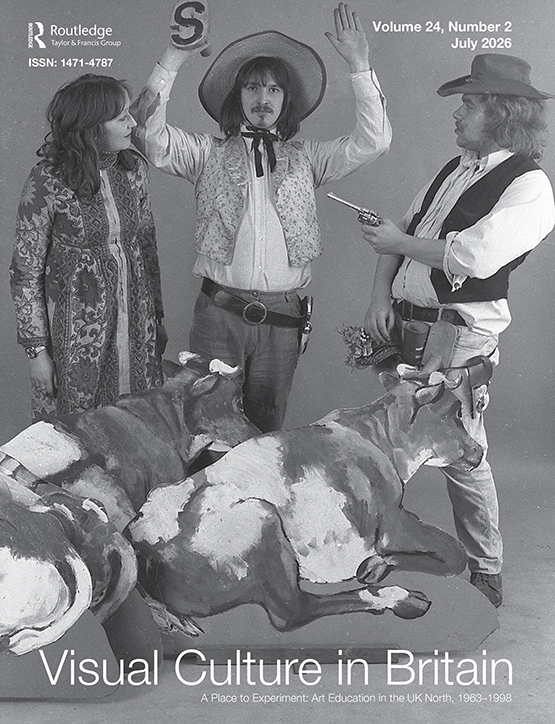
A Place to Experiment
Art Education in the UK North 1963-1998
Edited by Gavin Butt and Ysanne Holt
Published November 2026
Visual Culture in Britain Vol 24 Issue 2The subject of art education and the UK north in general – northward of an imaginary line between, say, Hull and Liverpool in England, and inclusive of Scotland and Northern Ireland – has received relatively little scholarly attention. This special issue of Visual Culture in Britain gathers together new work which directly addresses the importance of an art school education across specific locations in the UK North in the belief that (a) what has happened historically within and around the art school has been impactful for regional, national and international culture and (b) that the possibilities and limits of an art school education have been variously, and sometimes decisively, marked by the economic, social and institutional determinations of geographic place.
By the 1970s and 1980s new areas of disciplinary practice and bespoke studios and technical resources began to be rather unevenly established across different institutions and departments, enabling students to experiment beyond the traditional plastic arts: in performance, film and video, sound and music. The period also saw the emergence of conceptual art and political/theory-based critiques of modernism, the impact of feminism and Black politics, and the rise of para-academic student activities in community and political contexts. In the North the later 1970s and 1980s saw the rise of performance art at Belfast School of Art, of live art and time-based media at Newcastle Polytechnic and at Dundee; of feminist history, theory and practice notably at Leeds University with Griselda Pollock; and the Environmental Art Programme at Glasgow School of Art with David Harding and Sam Ainsley from the mid-1980s onwards.
The essays in this volume provide case studies of additional scenes and groupings in Aberdeen, Bradford, Leeds, Liverpool, and Newcastle to expand the limited understanding we have today of the histories of experimental approaches across the North. The period covered by this special issue spans the shared experience of peripheralization and marginalization across these cities, especially as they were hit from the 1960s and 1970s onwards by patterns of de-industrialisation, social and economic decline, urban decay and unemployment leading to an increased North–South divide somewhat reminiscent of the 1930s. Equally, however, the case studies collected here tell stories of uneven development: of localised instances of economic boom, community and infrastructural invention, and trans-local initiative.